Skip to content
Rosh Hashanah 5786
by Rabbi Nathan Kamesar
In the course of my prayers these days, I do a lot of just sitting and listening: sitting and letting my heart, my spirit, wander, seeing what comes.
Recently, what has come to me was a leadership course I took in rabbinical school during which we were asked to articulate a purpose statement for ourselves: essentially, what was the “true north” of our rabbinate? What was the fundamental underlying basis, the cause, for why we had chosen to become rabbis?
I still remember my statement, and I want to share it with you, recognizing that its contents might surprise some of you:
My purpose, I said, is to help people connect to God: to explore, in an ongoing way, their relationship with the Divine — however they understand that — in ways that nourish them, that strengthen them, that give them life, that call them forth to acts of love, and kindness, and justice; in the same ways that — on my best days — I have felt nourished, and strengthened, and enlivened, and called forth, through my own relationship with God.
I say this answer might surprise some of you because I recognize that in liberal Jewish communities like ours, and frankly, in all Jewish communities, among the Jewish people writ large, we have deeply ambivalent relationships to God, sometimes even antagonistic. We see a world riddled with injustice, and we ask how an omnipotent God could stand for this; our liturgy sometimes seems to suggest God as the bearded king in the sky, and some of us reject these seemingly patriarchal, old-fashioned depictions; we are followers of science, imagining science and religion to be oppositional rather than complementary, and so, we leave God on the shelf for others to engage with.
So while many of us feel connected to or are exploring our relationship to being Jewish — we love the traditions, we love the community: beautiful, central parts of what it means to be a Jew — when it comes to a relationship with God, it feels too complex, too obscure, too loaded, to engage with deeply.
And yet, I’m here to share, as my purpose statement intimated, that a personal relationship with God — even recognizing that it is shrouded in mystery, uncertainty, and complexity — can be the most profound, nurturing, electric, and dare I say, Jewish force in our lives.
I recognize that there are going to be widespread differences in each of our relationships to God, whatever that word means to each of us. Fundamentally, we know that the word for Israel — we are B’nei Yisra’el, after all: the People of Israel — refers to that foundational moment of Jewish life when our ancestor, Jacob, wrestled with a mysterious divine figure. Jacob wrestled with this figure whom he encountered on the banks of a river and would not let go. Until, that is, the mysterious figure relented and gave Jacob the name Yisra’el, for, said this mysterious figure, “you have wrestled, sar, with beings divine — el — and human, and prevailed.” Sar el, yisra’el. That is all of us, tradition teaches: each of us has inside of us the capacity to wrestle with beings divine and human, and to prevail, however mysterious that concept may be.
I developed a positive relationship to the mysterious quality of this teaching through a different central text in Jewish tradition. In this one, Moses has just mended the relationship between God and the people of Israel after the devastating experience of the construction and worship of the golden calf. Moses then boldly turns toward God and says, har’eni na et k’vodekha: O, let me behold Your presence. Let me see You, let me understand all there is to know about You.
And God answered אֲנִי אַעֲבִיר כׇּל־טוּבִי עַל־פָּנֶיךָ “I will make all My goodness pass before you, and I will proclaim before you the name יְהֹוָה and the grace that I grant and the compassion that I show,” “but,” לֹא תוּכַל לִרְאֹת אֶת־פָּנָי “you cannot see My face,” you cannot see all of me כִּי לֹֽא־יִרְאַנִי הָאָדָם וָחָי “for no mortal may see Me and live.”
When it comes to God, we are inherently wrestling with mystery. That is definitional to who and what God is. If we knew all there was to know about God, it wouldn’t be God. We will never know why we live in a world that contains so much heartache and pain and injustice alongside so much soul and joy and inspiration. Why we live with mortality and loss. Why sometimes the righteous seem to suffer, and the wicked prosper. We will never have all of our answers. We have Jewish tradition: we have our story; we have the mitzvot, the sacred actions we are called upon to fulfill; we have community, we have each other. But we will never have all of our questions answered.
But the recognition that we don’t have full clarity on why the universe works the way it does, that we won’t ever know all there is to know about God, is by no means the same thing as saying it’s not worth engaging with God, that God can’t be the source to which we all connect, around which we might all orient our lives.
A rabbi was once on a journey to visit the renowned tzaddik, the renowned spiritual master, Rabbi Hayyim of Sanz. On the way, he met a distinguished scholar who was a mitnaged, an intellectual who vigorously opposed mysticism and spirituality. The distinguished scholar asked the rabbi: Why do you go to so much trouble to visit the tzaddik, the spiritual master? Why don’t people come to see me?”
The rabbi answered: “The Tzaddik of Sanz knows all the thoughts that people have, and I, too, know some of them.”
“In that case,” said the scholar, “tell me what I am thinking about.” The rabbi answered: “You are thinking about the greatness of the blessed Creator and that the creator is present everywhere in the world.” The scholar triumphantly declared, “I can swear to you that I was not thinking about that, neither now nor at any time in the past.”
“And that,” the rabbi answered, “is why I and others travel to the Tzaddik of Sanz, for I can call heaven and earth as witness that he is in constant d’vekut, connection with God, as much as he can.”
For me, this connection has been my lifeblood, the salve for a parched soul; my support in times of crisis and anxiety, a reassuring voice, communicating that, in this life or otherwise, things will be okay; my source for a sense of purpose and direction: my sense that we each have tasks that we need to fulfill, sparks of light that we need to lift up, a corner of the world whose repair we are each responsible for, the source for my understanding that the world needs each of us.
Now, just because we may be aspiring for an experience of connection with God doesn’t mean we will immediately find it at the level upon which we are seeking it. If God is by definition mysterious, if that’s inherently a part of who and what God is, then there is inherently going to be a quality of evanescence, elusiveness, to our connection with God, a connection that is more pronounced in some moments than others.
At times we experience glimmers, feelings, experiences of what seems to be the wave of God, carrying us to shore; at other times it feels like we come up empty; like trying to tune into radio driving through vast stretches of uninhabited desert, no signal piercing through the noise. Sometimes the divine tuning fork rings in our spirit, sometimes it may just feel like we’re just calling into the void.
The biblical book Shir Hashirim, Song of Songs, which Rabbi Akiva described as the holiest work in Jewish scripture, alludes to the fluctuating quality of the relationship between God and humanity, God and individual human beings, the two yearning for one another.
“O my dove, in the opening of the rocks, Hidden by the cliff, Let me see your face,” the author of the song says, unclear whether the author here is meant to be Israel yearning for God, or God yearning for Israel, yearning for us. “Let me hear your voice,” the author says, and continues:
At night
I sought the one I love —
I sought, but did not find.
I must rise and roam the town,
Through the streets and through the squares;
I must seek the one I love.
I sought but did not find.
Scarcely had I passed the watchmen patrolling the town
When I found the one I love.
When I did, I held on fast and tried not to let go.
(Song of Songs, Chapter 3)
This sense of yearning, of seeking and finding, of searching, coming up empty and then connecting, is a central articulation of the religious experience.
But just because we can’t always preserve the exact same feeling doesn’t mean the relationship shouldn’t endure. Just because the Israelites weren’t always standing at Sinai, experiencing the lighting and thunder and grand revelation, doesn’t mean they, we, haven’t been sustained by the relationship for generation after generation. We very much have.
About this, Rabbi Abraham Joshua Heschel writes, “the life of the spirit is not always at its zenith.” Flashes of insight “come and go, penetrate and retreat, come forth and withdraw.”
“In every man’s life,” he continues, “there are moments when there is a lifting of the veil at the horizon of the known, opening a sight of the eternal.” Each of us has at least once in his life,” Heschel boldly states, “experienced the momentous reality of God,” but he says, “The immediate certainty that we attain in moments of insight does not retain its intensity after the moments are gone. To some people,” he says, “these moments are like shooting stars, passing and unremembered.” “In others,” and here is the invitation, “they kindle a light that is never quenched. The remembrance of that experience and the loyalty to the response of that moment are the forces that sustain our faith. In this sense, faith is faithfulness, loyalty to an event, [loyalty to a moment,] loyalty to our response.”
I have had such moments, and I’ll share one.
Now, to understand this moment, you need two pieces of context. Piece of context number one, which many of you already know, is that my father was a rabbi who died very suddenly and unexpectedly at the age of 35, just a few months after he graduated from rabbinical school. I was seven at the time, and my two sisters were four years old and four weeks old, respectively.
Piece of context number two, very much related, is that before my father died, my childhood had been one where Judaism and spirituality were central: bedtime stories from the Torah, images of my dad praying to himself, a Jewish day school education, and time regularly spent in our synagogue. The seeds of my parents’ faith were planted deep within me. Even if, over the course of my teenage years, that faith had withered on the vine to some extent, the roots were still deep.
Both are important pieces of context for the following moment, which I have shared before: Despite the fact that my relationship to Judaism had atrophied by the time I got to college, I still taught Hebrew School then; a job was a job after all. And I was teaching my fifth grade students the Amidah, the central standing prayer of Jewish tradition. We were using Kol Haneshamah, the Reconstructionist prayer book, which, like the prayer book we use at Society Hill Synagogue, contains commentary on each page. I’ve shared the commentary that struck me so many times before, that I’ve committed it to memory.
It was a comment on the phrase, zokher hasdei avot v’imahot — Blessed are you God who remembers the hesed, the loving acts of our avot and imahot, our ancestors. Blessed are you God, who remembers the acts of hesed, of love, of our ancestors, the blessings from which, tradition teaches, flow down to us.
But as the commentator pointed out, avot and imahot doesn’t just mean ancestors; it means… parents. “Blessed are you God who remembers the love of parents,” the text can mean. The commentator continues, “The legacy each generation gives to its children inevitably contains within it pain and hurt, a sense of inadequacy and task unfulfilled,” continuing: “Some children are hurt when parents are taken from them too early, others by parents who did not know how to show their love.” “We say,” the commentator concluded, ‘that God remembers the love of parents.’ God is the one who sees to it that the love is remembered, even when parents are unable to transmit it.” Then I see the author of the commentary: Daniel Kamesar, my father.
You want to talk about a flash of insight. A moment in which there is a lifting of the veil at the horizon of the known, opening a sight of the eternal. It would have been hard for even the deepest skeptic not to feel a sense of godliness in that moment. Here I have a text not only telling me our tradition teaches us that God transmits love from parent to child when the parents are unable to transmit it themselves, but the very author of that piece is my father, unable, at least on this plane of existence, to do the very same.
So I have had my moments of insight, moments when there is a lifting of the veil at the horizon of the known, opening a sight of the eternal. And I treasure them greatly.
And yet I’ve also had my moments to question. Put aside my father’s sudden death, and a fairly traumatic childhood involving multiple subsequent remarriages and divorces, multiple cross-country moves, consistent instability. There is also an epilogue to this story that I have not yet shared publicly:
Years after I discovered this commentary in the siddur, a professor of mine at the Reconstructionist Rabbinical College, the rabbinical school that ordained my father and which supported the publication of the siddur which contained this commentary, attended a Shivah minyan. My professor attended the Shivah minyan for the late wife of my father’s teacher and mentor, who had been president of the college when my father was a student there.
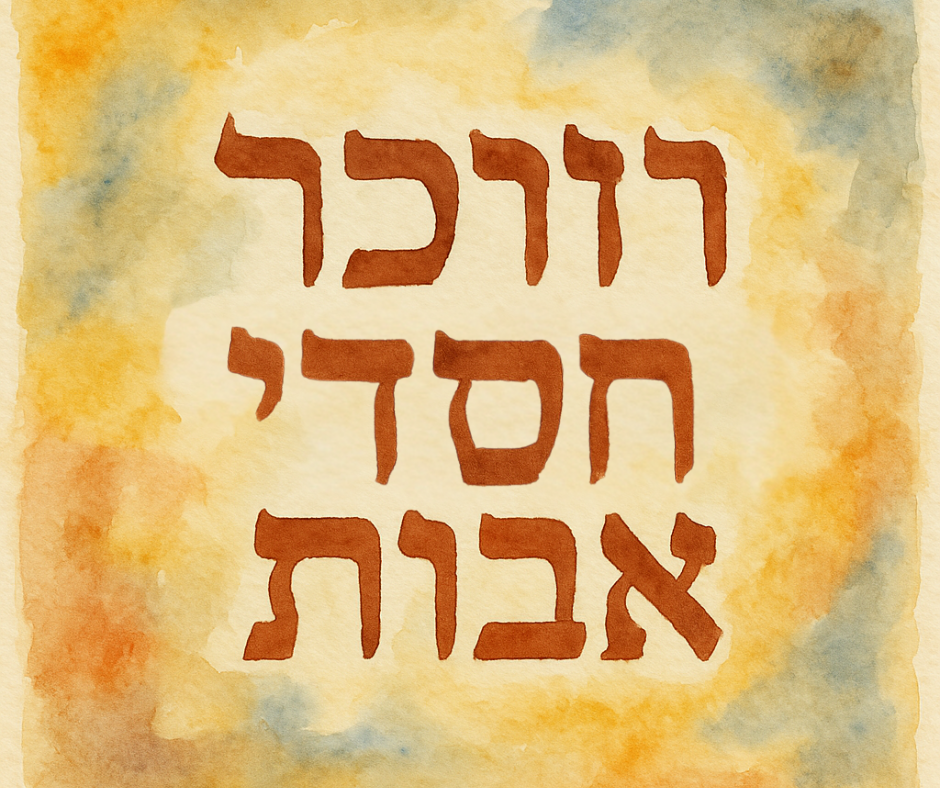 At the Shivah minyan was a pamphlet of writings contributed in his teacher’s late wife’s honor, including one from my father’s mentor, her husband, and it went as follows: “The last time my heart was broken as much as now” in losing his wife, he wrote, “was at the sudden death of Dan Kamesar, a most beloved student of mine… who had become a dear friend.” “I was truly devastated by that loss,” he wrote, “so much so that I decided to say Kaddish for him for that entire year.” Now, “sometime during that year,” he wrote, “one morning while davening, I had a new understanding of – “וזוכר חסדי אבות of God remembers the compassion of the ancestors.” “Avot,” he continued in his writing, “does not just mean ancestors. It means “fathers, parents.” “Think of all those parents,” he continued, “who are filled with love for their children, but never succeed in conveying it to them. Maybe, like Dan, they die too soon. Or maybe they get divorced and don’t see enough of their children to tell them of their love. Or maybe they are just unable to express it, as so many men are. God, I said,” this teacher writes, “is the one who gathers up that undelivered love, saves it, and passes it on to the children and grandchildren who so much need it.”
“It felt to me,” he concludes, “like this insight was a gift from Dan, passing through into my mind from ‘the other side.’”
My teacher shared this with me not knowing anything about the existence of the commentary in the siddur by Daniel Kamesar, just thinking I would find it interesting that this other teacher referenced my father. Let me tell you the chain reaction of experiences I had upon reading this writing:
Reaction number 1. No, no. My father’s teacher has this wrong. My dad wrote this. My father’s teacher innocently forgot the source for this teaching. This happens all the time. In music, for example, a melody, like an earworm, works its way into your brain: you don’t remember that you learned it externally rather than internally, and you internalize it as your own. My dad did write the piece, and his teacher misremembered.
Reaction number 2. And I am talking about seconds later. No he didn’t. His teacher wrote this. And he attributed it to my father in Kol Haneshamah, the Reconstructionist prayer book, something this teacher could do as President of the Reconstructionist Rabbinical College. This writing of my father that had served so long for me as essentially proof of the Divine through its prophetic nature was potentially no longer so prophetic. A communication from my father to me, reassuring me that everything was okay, was no longer from him.
Reaction number 3. And again, seconds later: Or wasn’t it? Does that even matter? How is this actually any less a manifestation of divinity than my original understanding of the text’s transmission, that my father literally wrote it? Since when have we Jews required the literal truth of a sacred text in order to feel its power? If I can’t find the divine in a text that, in at least some respects, helped me resurrect my faith, because years later I encountered it from a different angle, then I’m not sure what I was looking for. What is the actual nature of the miracles we are looking for, the suspension of the laws of nature, or finding god present in some way wherever we look?
In my view, the phrase “believe in God,” is a misnomer. “Belief” suggests something cognitive, something intellectual, like a determination has been in your mind through a series of deductions, and someone decides I now believe or do not believe in God.
Instead I would point out the proper name for God is made up of the letters YHVH. While that word itself is unpronounceable, there are other permutations of the word we can pronounce. One is havayah, which means experience, or impression. The One Whom I Experience. The One Who Leaves an impression. Instead of do we believe in God, perhaps the question should be “do we experience God,” or “do I experience God as having left an impression on me?”
I can tell you that God has left an impression on me.
Some of you may have a different understanding of what transpired here. Maybe you don’t see the hand of God present. Lord knows, there’s reason enough out there to have doubts. The world has much heartache in it. With every single glimpse of the news, experiences of our own lives, we are reminded of that.
But I’ve never understood the Jewish relationship to faith to be one where we expect God to right all the wrongs for us, and that if God doesn’t, then that’s disqualifying to God’s existence. God, as Jewish tradition says, is present where we let God in. Faith is faithfulness, to those moments of clarity echoing in our souls.
Which moments? Well, we are all invited to search our lives for those experiences, and we are also invited to reflect upon the moments we’ve experienced as a collective, as a people, as a community.
Each morning and evening during a traditional Jewish prayer service — every day, something that can be done in our homes, not just on holidays in the synagogue — a series of blessings surround the Sh’ma, that central affirmation of Jewish faith, and each of these blessings are about those ultimate moments of Jewish life, of the Jewish story, when there has been a lifting of that veil at the horizon of the known.
The first blessing, the first moment, is the moment of creation. We are invited to transport ourselves to the dawn of time, before there even was time. We’re invited to imagine ourselves, present at that first spark, that first bang if you will, inviting ourselves to experience how small we are in relation to these majestic cosmos, to the majestic span of time and space. Barukh Ata Adonai, we say, blessed are you, source of being, yotzer ha’me’orot, you fashion the radiant lights. The awe that fills us in experiencing that moment of creation is one means of experiencing the lifting of the veil, of connecting to the Divine.
But no sooner have we internalized that moment, have we been present to that moment, than we are transported to a different moment, eons later, the moment at Sinai. The second blessing before the Sh’ma moves us from that grand majesty of the spark of creation spiraling into a seemingly unending cosmos into a moment when God is not beyond but profoundly within human concerns. The teaching of Sinai is that God cares about us and what we do, no matter how big and vast the universe seems. We are not lost at sea: we have a map, a map made manifest in a brit, a covenant, a set of pathways and teachings and traditions and values for us to pursue. We have a roadmap, even if we understand that roadmap to be evolving through time, even if we don’t read it literally. We connect to God through a moment when God said, what you do matters to me, I care about what you do, I care about the choices you make and the values you uphold, and when you fail — and you will fail — I will create a pathway back to me. We connect to God through the way in which God cares about us and has laid pathways for us to live out our lives. That’s what was made clear at the moment of Sinai, about which we say, ahavah rabah ahavtanu, you have loved us deeply, Adonai our God, as made manifest in the pathways you have laid out before us to do what is good and true.
Finally, after the Sh’ma, we lift up a third moment, and though in the story of Israel, it comes before the moment at Sinai, in our searching to connect to God, it is the culminating moment, a moment which symbolizes the future redemptive moment for which we yearn: the moment at the sea. Remember that the moment at the sea represents the moment when we were at our lowest depths. Having experienced years of our heartache and despair, we could nearly taste freedom, but bearing down on us from behind came the forces arrayed against us, and stacked up in front of us lay a stormy sea. And yet despite those stormy circumstances, through the leadership of Moses, through the bravery of that first Israelite willing to step in the sea, and through the awesome power of a loving God, we experienced redemption. We made it across.
We can connect to God, if we feel so moved, through these three moments — creation, revelation, redemption transporting us through our imagination to moments of connection.
And at the center of all of that, we “Sh’ma”, we listen: we listen to the stirrings in our soul, to the reverberations of the divine, seeking to tune in to our relationship to the Holy One. We see what comes. Doing that this year, in preparation for this season of the Yamim Nora’im, the Days of Awe, I was reminded of at least one of the purposes of my rabbinate: to invite you, alongside me, to explore our own relationships to the divine, however we understand that. Wishing you each a year filled with moments where there is “a lifting of the veil at the horizon of the known, opening a sight of the eternal,” a year filled with goodness and holiness.
Shanah tovah.