Skip to content
by Rabbi Nathan Kamesar
In a few moments, we’re going to sing the beautiful words and haunting melody of Ahat Sha’alti from Psalm 27, a psalm which tradition teaches that we chant every morning and every night from the beginning of the month of Elul, the last month of the Jewish year, through Rosh Hashanah and Yom Kippur and the ten days in between up through all the days of Sukkot. It’s a practice I have taken up in full this year, and so its words have been sitting with me more profoundly this year, urging me to reflect more on the psalm’s meaning.
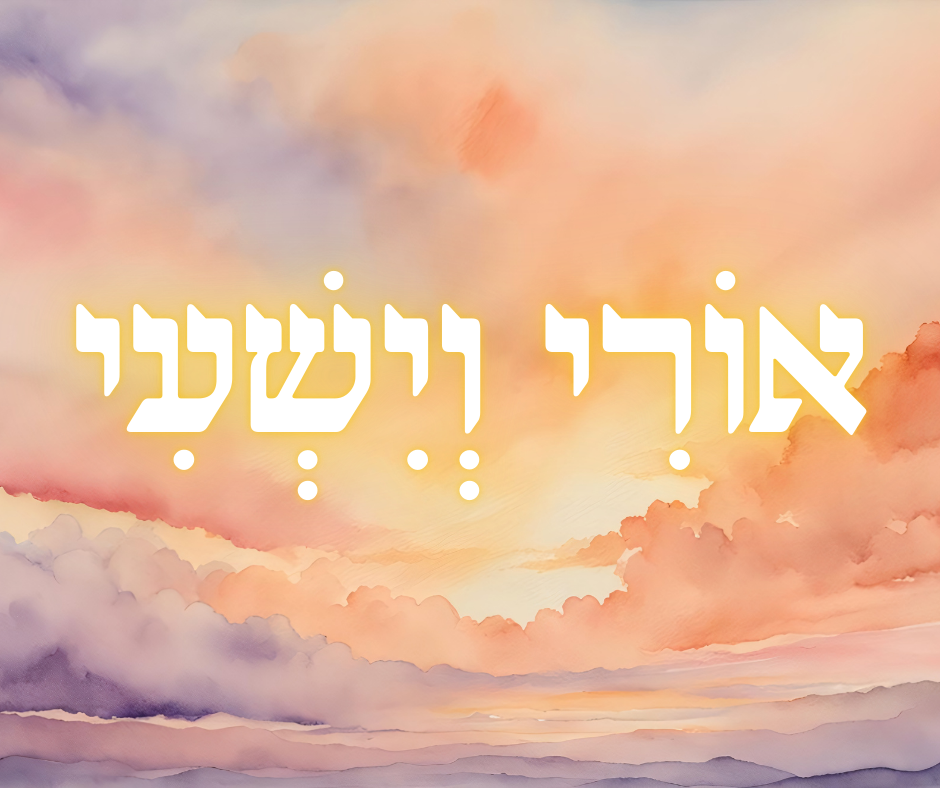 The psalm, which can be found on page 59, begins with the words Adonai ori v’yishi, God is my light and my salvation. A midrash teaches that these two phrases refer to Rosh Hashanah and Yom Kippur, respectively: God is my light on Rosh Hashanah and my salvation on Yom Kippur, recognizing the special sense of hope we are invited to feel on these two days. This is followed just a few verses later with the words, ki yitzpeneni b’suko b’yom ra’ah: in a time of calamity, you shelter me in your sukkah, the holiday of Sukkot following on the heels of Rosh Hashanah and Yom Kippur. So already it begins to become clear why rabbis selected this psalm for this season as a meditation: it gives us a sense of hope, and light, and shelter, as we engage in the season of t’shuvah, the season of looking inside of ourselves in order to make a proper return, a season of repentance and repair to the full goodness of who we are, reminding ourselves of the protective light and spirit we can feel as we engage in that practice.
The psalm is not without a sense of foreboding; this hopefulness would only be necessary in the face of the recognition that life is sometimes scary and lonely. “Do not hand me over to those who besiege me,” it says, “for false witnesses who breathe hatred have risen against me!” The psalmist, often thought to be King David in the midst of a series of wars, sometimes on the run from his foes, can be imagined to have experienced these types of circumstances, applicable to some of us on a metaphorical level, to others of us even on a literal one.
Still, there is a sense of comfort in the midst of anxiety, hope in the midst of darkness, and the psalm closes with something of a sacred note to self: קַוֵה אֶל־יְהֹוָה חֲזַק וְיַאֲמֵץ לִבֶּךָ וְקַוֵה אֶל־יְהֹוָה Place your hope in Adonai. Be strong and take courage and place your hope in Adonai.
But there is a different phrase from the psalm that has lingered with me this season, and that’s a phrase found a few verses above, where it says, לְךָ ׀ אָמַר לִבִּי בַּקְשׁוּ פָנָי אֶת־פָּנֶיךָ יְהֹוָה אֲבַקֵשׁ
It is You of whom my heart said, “seek My face!” It is your presence I seek, Adonai.
This is a deeply mysterious phrase which we have to break down for a moment:
It is You, God, of whom my heart said “seek My face!” What we have here is each of our own hearts seemingly acting on their own. Our own hearts, according to this psalm, are talking to us. And they are saying seek My — with the “My” here being “God’s” — face. Our heart, the psalm says, is channeling the voice of God, talking to each of us, and saying “seek My face.” The way Rashi, the preeminent commentator in Jewish tradition, describes what is happening here is the following: Each of our hearts is God’s shali’ah, is God’s agent, is God’s messenger, and it is saying to us, seek My face. My as in God.
Put aside for the moment the complicated theological question of what does God’s “face” mean; we know that expression shows up in a lot of our liturgy like in the priestly blessing that parents say to children, ya’er Adonai panav elekha vi’yhunekha, may God’s face shine upon you and be gracious to you.
More profound to me is the notion that each of our hearts is God’s shali’ah, is an agent of the divine trying to speak to us from the inside, knocking at the door of the soul. saying, let me in. This, too, can sound foreboding, or it can sound inviting. Understanding as we might the experience of God as elucidated in the rest of this psalm, one providing hope, and light, and spiritual shelter, this is hopefully a profound invitation, a profound call: find me, seek me, know me.
It makes sense to me that the heart would serve as the vessel that calls out to us in that way: our heart is the vessel that aches, that twinges, it breaks, it heals, it yearns, it flutters, it races, it sinks, it soars, it hardens, it bursts open.
It makes sense to me that of all the vessels inside of us, if one is serving as the agent, the messenger of the divine, it is the heart.
The heart opens and invites us to “seek my face” to know, to connect, with the divine.
It reminds me of another tale of Jewish tradition, as retold by Danny Matt, this one from the holiday of Passover, which teaches that the heart is the portal to the beyond:
Once, before Passover, according to a Hasidic tale, the disciples of Menahem Mendel (the Kotsker Rebbe) complained to him about the disappointment of not finding the prophet Elijah at the door. And so Rebbe promised them that Elijah would be revealed to them at the upcoming seder. On the first night of the festival, the room was full, the atmosphere charged, with Elijah’s cup waiting on the table. The seder proceeded, and finally the door was opened. What happened next left the disciples astonished. Nothing; no one appeared. Crushed, they turned to their Rebbe, whose face was beaming. Seeing their distress, he asked, “What’s troubling you?” They told him. “No!” he thundered. “Do you think Elijah the prophet enters through the door? He enters through the heart.”
May each of our hearts in this season of t’shuvah serve as a doorway to the divine, and may you have a sweet new year inscribed in the Book of Life. Shabbat shalom.