On Wednesday I bore witness to mourning and remembrance of the horrific events of October 7, 2023, the Hamas-led attacks on southern Israel in which 1,200 people were killed and 251 others were taken hostage, igniting a conflagration of war, resulting in the deaths of tens of thousands more in Gaza and all around the region. In Jewish tradition, we say that to save one life is to save a world; to extinguish a life is to extinguish a world. That is a lot of worlds that we’ve failed to save over the last few years.
I’m also holding how those events changed the experience of being Jewish in this country. As I spoke about on Rosh Hashanah, to be Jewish means to have a sense of connectedness to one’s people as a whole, to have the sense of being part of a larger tribe: a joinable tribe. The journeys that this tribe has been on — the experiences of homecoming and exile, our journeys together around the world — the traditions and spiritual practices we’ve inherited, the ethical callings we’ve heard and sought to respond to — all these have served as sources of strength and connection and nourishment for us. They have all helped establish the foundation for us to help make a broken world more whole and to better experience its holiness. It doesn’t mean we’ll always get it right or that we’ll always be operating in lockstep with one another, in harmony with one another; but our shared basis for gathering and connecting, our sense of tribal, mutual responsibility allows us to feel more fully known in this world and to more fully know others in turn. Not to the exclusion of others: ideally we take the strength we draw from one another, and through it, foster a shared sense of humanity all around us; but neither are we comfortable with others taking a sledgehammer to that shared foundation, telling us that our Judaism should not have us experience a sense of connectedness and mutual responsibility for other Jews all around the world.
According to recent surveys, 71% of American Jews feel emotionally attached to Israel, and 88% of Jews believe in Israel’s right to exist as a Jewish state.
And yet, more and more, as many seek to turn Israel into a pariah state — an Israel that is certainly not without significant faults — any level of connection to Israel is vilified.
On Wednesday night in New York, a coexistence vigil organized by the left-wing group Israelis for Peace that sought to mourn both Israelis and Palestinians killed in the conflict was drowned out by pro-Palestinian protestors who occupied seats intended to be reserved for mourners. Even the acknowledgement of Israelis who had been killed was a bridge too far for these protestors. Instead, a poster was waved depicting the face of Yahya Sinwar, Hamas’ leader in planning the October 7, 2023 attacks. Also chanted was “we don’t want no two state, we want ‘48,” a rejection of the notion of two states living side by side, protesting instead for the elimination of Israel, hence the reference to the state’s founding in 1948.
On the same day, we learned that a Chicago Jewish theatre cancelled a planned revival by a New York-born Israeli novelist and playwright because, according to an email shared by the playwright from the theatre’s artistic director, “People were seeing you [the playwright, as] a pro Zionist Jew/Israeli and I was bombarded with actors, directors and designers who were actually afraid that doing a show with you as playwright would hurt their careers.”
On the same day we also learned that a Haverford professor who had called antisemitism complaints “Zionist witch hunts”was charged with cyberstalking, allegedly sending roughly 50 threatening messages to an unidentified Jewish person between October 2025 and May 2026. This included messages such as “Eliminate the Jewish cockroaches. Exterminate the Jewish state.” This came after Haverford College had already reached a settlement with Jewish students who had filed a lawsuit against Haverford College, where, according to the lawsuit, professors had contributed to an antisemitic environment on campus.
No one person, chant, or protest represents everyone in any political orientation. And yet we have witnessed time and again this level of social ostracization against Jews holding any level of connection to Israel, and even against Jews who seek to distance themselves from Israel, if that distancing is seen as insufficient.
Our north star is that we are all created in the image of God. We hold Hillel’s teaching from Pirkei Avot: If I am not for myself, who will be for me? And if I am only for myself, what am I? Each of those is an important planks of Torah.
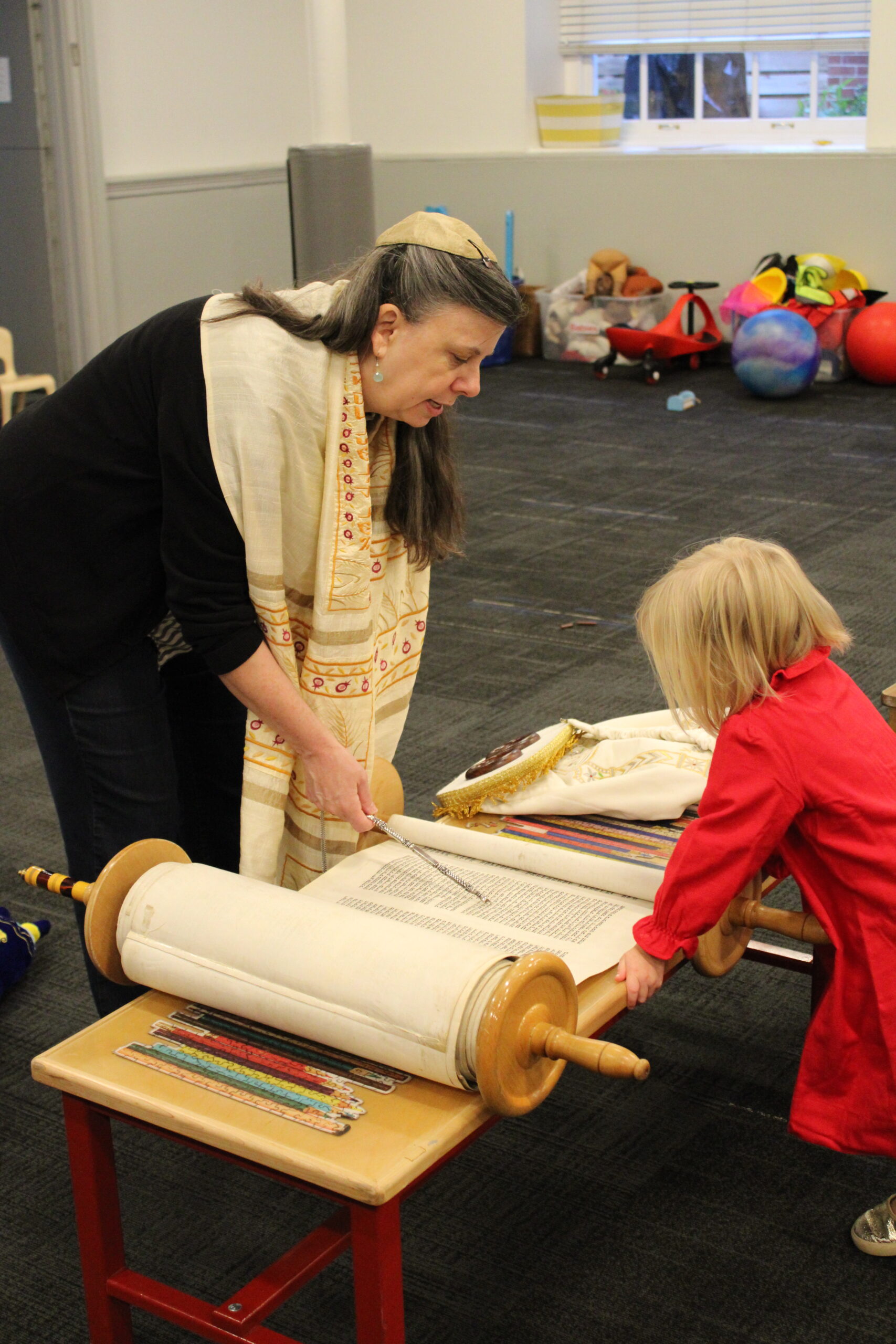
Speaking of Torah, on the Eve of Simhat Torah, I shared the following teaching this past Friday night about our approach to Torah:
On one level, I’ve never really participated in a book club. Maybe it’s because I was in school for so long: law school, a master’s program, rabbinical school. School is kind of one long book club, after all, where there are assigned readings and then you talk about the readings — only, because there are grades, all the fun is taken out of it.
So I’ve never really had the experience of opting into a book club, where I read a text, for the sheer joy of reading and learning, and then get the opportunity, with friends and peers and colleagues, to discuss and debate and reflect on the meaning of that text — what it teaches me about my own life, and about the world around me.
Or haven’t I?
On Shabbat, and on the eve of Simhat Torah — the holiday which celebrates the joy of completing a cycle of reading the Torah, our sacred text, and then immediately starting it all over again — some of you may have intuited where I am going with this: which is to say how grateful I have become for the experience of doing exactly that, of engaging in study and reflections of a text, with friends and community, in what amounts to the longest running book club in world history: talmud Torah, the reading, study, and discussion of Torah.
In line with the Book Club analogy, one thing that’s important to recognize about the reading and study of Torah is that the project is not really complete if you’re doing it on your own.
If we think about the many Jewish practices that we modern Jews engage in, in truth, Torah study is not among the most common. If I were building something of a Maslow’s pyramid of how many of today’s Jews engage in which Jewish practices, at the top of the pyramid I would put the Passover Seder and the lighting of Hanukkah candles, maybe just above life cycle moments, like celebrating a bar or bat mitzvah, having a bris, and including Jewish traditions at a wedding or a funeral. Then maybe it’s attending High Holiday services, followed by some Shabbat practices like lighting candles, and only then are you reaching the next tier which includes prayer and Torah study.
That’s because if you crack open a Humash, a copy of the five books of Torah, it’s not necessarily the most accessible text, at first glance. You may find yourself in a series of laws which haven’t been practiced in ages; you may find yourself in the midst of a violent conflict; you’re certainly likely to encounter some family turmoil; and it’s a long, arduous journey from the creation of the world to the precipice of the Promised Land. It is not for the faint of heart.
But once again, we are encountering a practice in Jewish life that is not really meant to be done alone.
For generations now, even the most renowned of rabbis have not approached this text without scaffolding, without supports, unmediated by the interpretations of generations of Jews.
Traditional Jews, for example, almost never read a verse of Torah without referencing Rabbi Shlomo Yitzhaki, better known as Rashi, an eleventh century French rabbi and commentator, who systematically went through the Torah verse by verse, to share, where it is confusing, what he sees as the peshat, the plain meaning of the text, and also the drash, interpretive teachings on the verse by ancient rabbis, turning to the rabbis who came before him to help him understand the text.
When studying Torah, the Jewish practice is to be in conversation with the generations of Jews who preceded us, and, perhaps more importantly, to do so with communities of living Jews who recognize the same confusing elements, ambiguities, challenging moments and yet who work through it together.
I am usually not one to “toot my own horn,” as it were (maybe you’ll tell me otherwise), but if you come to Society Hill Synagogue on a Shabbat morning, or for many of our adult education classes, you’ll see what I am talking about: we take a verse or two of Torah, we introduce what other Jews have said about this verse in past generations, and we ask, where do we pick up this conversation in our own generation? How does this text, this tell, built upon in successive generations, facilitate a light for us in our own lives, cause us to look at life in new ways, with a new sense of purpose and meaning and commitment?
This brings us from the “how” of Torah study, to the why: what even is Torah and why bother studying it?
On one level, if you understand Torah to be the word of God, that is answer enough — if you have access to God’s word, you’re going to want to know what it says.
But even if that’s not quite your orientation to Torah, and for most liberal Jews, it isn’t, or we’d be living our lives differently, the practice of Torah study can still be deeply sacred and urgent.
According to the scholar Jonathan Cohen, the Jewish philosophers Martin Buber and Franz Rosenzweig argued that even if we don’t understand the Torah to have been literally written by God, study of Torah can indeed facilitate an encounter between humanity and the Divine. Both the significance of the text — its content and the fact that it has constituted the fabric of Jewish life for generation upon generation — and the sensibility that we bring to it, the openness that we bring to it, the humility we bring to it, “sensitizes us” Cohen writes to the possibilities of encounter, between humanity and the Divine.
The openness we bring to Torah, and the myriad interpretations we can find in it, in the context of community, elevates us, this suggests.
As Rabbi Art Green writes, “The power to reinterpret, the ability to expand meanings, is itself a divine gift, or a testimony to the divine presence within us,” continuing, “The text is a way into our own deepest selves, a tool for examining our inner lives.” He observes that there is an instruction in the Torah which says that the ancient kings of Israel were each called upon to write out the Torah in full and then “read in it all the days of their lives” The Hasidic reading of this, he teaches, is that we each become king-like when we learn to read (or “discover”) all the days of our own lives within the Torah, when we invite it to speak to us in these ways.
So it’s true: I have not yet joined the capital B-Book Club that meets monthly at Society Hill Synagogue, co-chaired by Donna Tartasky and Judith Axler, which I encourage you all to join. I am blessed, however, to have been able to participate for much of my life in a weekly gathering on Shabbat mornings, that invites me to immerse myself and feel transformed through my encounter with a sacred text, to see myself in the text and to allow it to transform me.
As we move tomorrow night into Simhat Torah, the joy of Torah, completing and beginning this process anew, I invite us all to immerse ourselves in this practice.

 On one level, I’ve never really participated in a book club. Maybe it’s because I was in school for so long: law school, a master’s program, rabbinical school. School is kind of one long book club, after all, where there are assigned readings and then you talk about the readings — only, because there are grades, all the fun is taken out of it.