We are thrilled to announce the hiring of Alexis Rosen as our new Manager of Community Engagement and Communications!
Many of you may know Alexis as the outgoing co-chair of the Young Friends at Society Hill Synagogue, which brings together 20- and 30-somethings — singles and couples — for Shabbat dinners, holiday celebrations, happy hours, and other gatherings here at the synagogue and throughout Greater Philadelphia. Alexis and co-chair Louis Polcin have helped build an expanding array of programs for this cohort in our synagogue. Matt Cohen and Erika Pleskunas, who joined our congregation in 2025 and got involved with the Young Friends while Alexis was a co-chair, are succeeding her as Young Friends co-chairs, alongside Louis.
In addition to sustaining the excellent communications work stewarded by LilyFish Gomberg, our outgoing Communications Manager — work which helps tell the story of what is happening at Society Hill Synagogue: the learning taking place, the connections being made, the spiritual and communal growth — Alexis will have an expanded portfolio, helping to nurture community at our congregation. She’ll help people find their place here, meeting new people and connecting them with the opportunities that are right for them, supporting our Membership, Hesed (Caring), and Development Committees in tending to relationships here at Society Hill Synagogue.
Alexis brings her ongoing love of Jewish life to this community, paired with the skills to communicate in the digital age. She earned her degree at Bar-Ilan University in Ramat Gan, Israel, an institution whose mission is to blend Jewish tradition with modern technologies and scholarship. She has worked as a communications and marketing professional in the private sector, and is so excited to take on this role at Society Hill Synagogue. Alexis’ first day as Manager of Community Engagement and Communications will be May 26, and we are delighted that she and LilyFish will overlap for two weeks — ensuring a smooth transition. I hope you’ll join me in welcoming Alexis to our team!
As the school year winds to a close — the last day of Hebrew School is Saturday, May 16 — we remind you that Society Hill Synagogue takes a break from our Friday night Shabbat services during the summer time.
However, we (a) continue our Shabbat Saturday morning services and Kiddush lunches throughout the summer, and (b) are launching our Summer Shabbat at Home series, in which members of the Society Hill Synagogue community are opening up their homes on select Friday nights throughout the summer, hosting a Shabbat dinner for the opportunity to connect together in the spirit of Shabbat.
What follows is the D’var Torah I offered this past Friday night at Shabbat services:
As we come to the end of the school year, I often find myself reflecting on what material we at Society Hill Synagogue have studied together this year which has stuck with me. We’ve hosted classes on antisemitism, and an introduction to Judaism; weekly Saturday morning Torah discussion, and Friday night services; but there is one story that we studied in the smallest class I have, on ancient rabbinic stories, that has stuck with me.
Our impression is that the lives of rabbis are very different from the lives of priests, in that rabbis, traditionally, get married and have a family and priests do not.
To be clear, this is an absolutely correct impression; that difference is real.
And yet, the ancient rabbis did have some ambivalence around how to negotiate their romantic life, their family life, with their dedication to Torah, to the study of Torah, which for them, had its own, quasi-romantic pull.
That ambivalence, that sense of feeling torn between the two, is the theme of a short, cryptic story that we studied from the Talmud, Ketubot 62b:
Rabbi Yehuda HaNasi, the president of the Sanhedrin, the great rabbinic court, went and arranged for his son to marry a daughter of the household of Rabbi Yosei ben Zimra.
Yosei ben Zimra’s house agreed that they would support Yehuda HaNasi’s son for twelve years to go to study in the study hall. Thus, the plan is for the young man and woman to have a twelve year engagement, a twelve year betrothal, during which the young man will go to bei rav, the house of becoming a rav, studying to become a rabbi, while cloistered away. At the kiddushin, the betrothal ceremony, they passed the girl in front of the groom, and when he saw her, he said “Let it be just six years.” They passed her in front of him again, and he said to them: “I will marry her now and then go to study.”
He was then ashamed to see his father (since he had been unable to commit to study prior to marriage). His father said to him: “My son, you have the same sensibility as your Creator.” There is a verse in the Torah, he explains, in which it is invoked that God will be bringing the people to the Promised Land, to Eretz Yisrael, where a mikdash, a sanctuary, will be made through which God’s presence can dwell among the people. But, the son’s father says, just a few chapters later, God invites the people to build a sanctuary in the wilderness that is portable.
In other words, Yehuda HaNasi assures his son that God couldn’t wait either for the opportunity to dwell among God’s people. God couldn’t wait until they got the Promised Land for the sanctuary to be built. God yearned for it on the way.
Just as the son couldn’t wait twelve or six years to be with his wife, God couldn’t wait to be among the people Israel. The father reassures the son that devotion to Torah, devotion to his calling, while important, needn’t eclipse the centrality of relationships in his life.
Not all rabbis got this balance correct. Another tragic story that we studied from Ketubot 62b goes as follows:
There was an ancient argument among the rabbis about how long students could be away from their wives in order to study Torah, without their wives’ permission. The consensus answer was, at most, 30 days. One rabbi argued that the answer, based on tradition, should be significantly longer: two to three years without permission. In response, another rabbi said that if students relied on that opinion, it might be at the cost of their lives.
So enters Rav Rehumi. He was accustomed to coming back to his home just once a year on the eve of Yom Kippur. One day he was particularly engrossed in the text he was studying, and so he remained in the study hall and did not go home. His wife was expecting him that day and continually said to herself: “Now he must be coming. Now he must be coming.” But in the end, he did not come.
She was distressed by this, and a tear fell from her eye. At that exact moment, Rav Rehumi was sitting on the roof. The roof collapsed under him, and he died.
This is the Talmud’s way, Jewish tradition’s way, of asserting its own ambivalence about the relationship between Jewish commitments, rabbinic commitments, professional commitments — and family commitments.
There is no doubt Judaism holds Torah devotion and study in its pantheon of values. A different rabbinic story highlights the wife of Rabbi Akiva, who in support of him urged him to study for twelve years. When Rabbi Akiva returned, he heard an old man say to his wife, “How long will you lead the life of a widow?” To which she replied, “if he listened to me, he would stay another twelve years.” Having heard this, Rabbi Akiva said, “then that is what she wants me to do!” And he returned to study for another twelve years.
And yet, Jewish tradition recognizes this dynamic as something of a platonic ideal that is suitable in reality for, essentially, no one.
Instead, it gives us these other stories that hold familial relationships as a central part of our Jewish leadership model.
I wish I could say it was easy to seamlessly balance these two; that it never felt like my family was sacrificing when I was serving the synagogue community, or that the synagogue community was never inconvenienced when I cordon off time with my family.
I’m afraid that’s not so. Caroline is often juggling bedtime with the kids without me, and synagogue committee meetings are often held at awkward times of the day or night so that I can balance all these responsibilities and attend.
Such is the model of rabbinic Jewish family life, one which I try to navigate sustainably, often stumbling in both directions, with a particular burden falling on Caroline, as some of these ancient rabbinic wives felt.
I cherish a rabbinic tradition that honors these tensions, these pain points, as I strive to navigate my own balance. The notion that God yearns for a relationality that is central to God’s existence underscores its importance for us all.


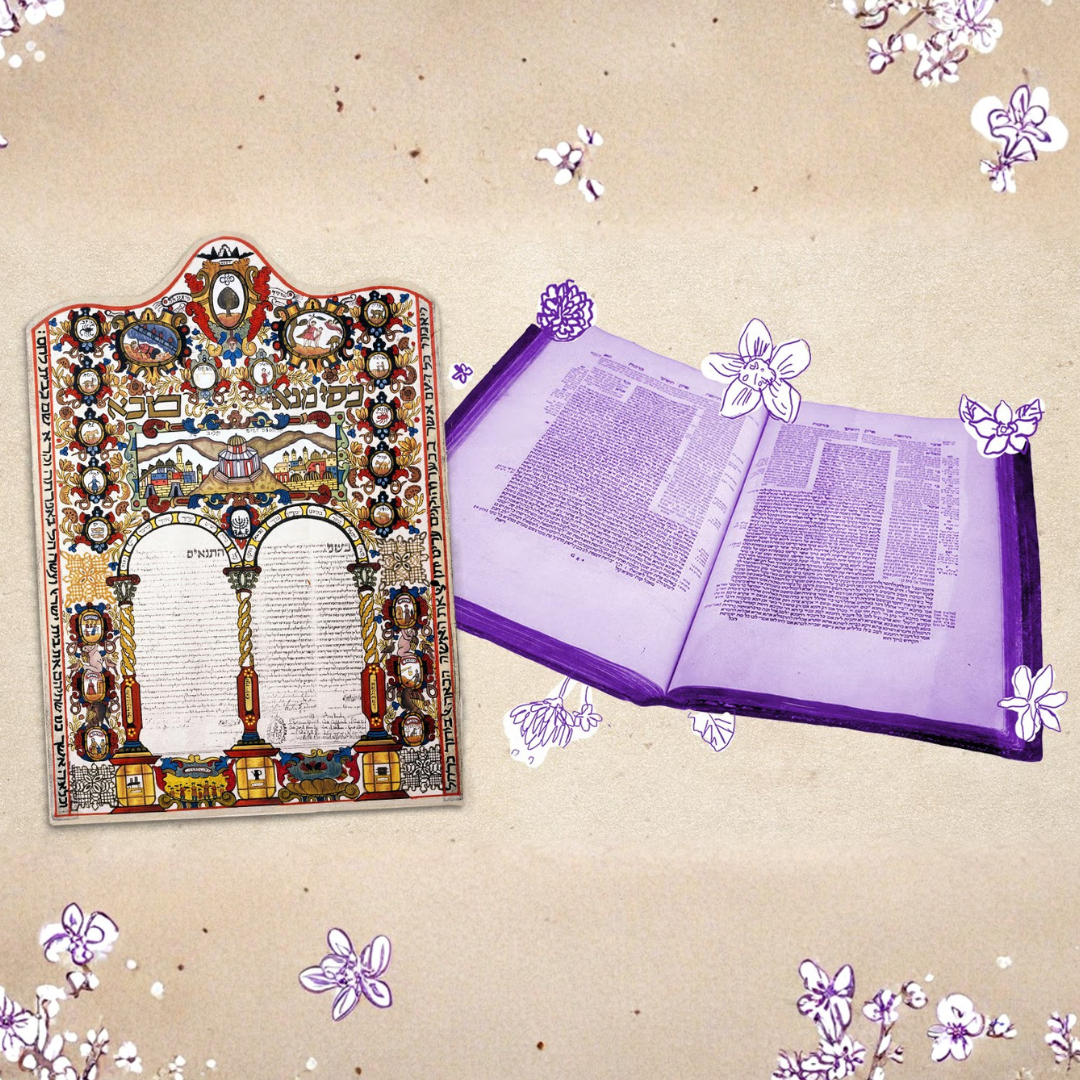 Rabbi Yehuda HaNasi, the president of the Sanhedrin, the great rabbinic court, went and arranged for his son to marry a daughter of the household of Rabbi Yosei ben Zimra.
 In other words, Yehuda HaNasi assures his son that God couldn’t wait either for the opportunity to dwell among God’s people. God couldn’t wait until they got the Promised Land for the sanctuary to be built. God yearned for it on the way.
 She was distressed by this, and a tear fell from her eye. At that exact moment, Rav Rehumi was sitting on the roof. The roof collapsed under him, and he died.
 I wish I could say it was easy to seamlessly balance these two; that it never felt like my family was sacrificing when I was serving the synagogue community, or that the synagogue community was never inconvenienced when I cordon off time with my family.